
Shared money still needs room for privacy
In development · Design prototype
dootang began with a question: how can people who share a life and manage money together see what they need to see, while each person still keeps a private space and clear boundaries?
For me, the question does not end with gathering income and spending in one place. The design also needs to address who should see what, and who makes that choice.
Visibility is a choice
The prototype distinguishes Private, Shared and Selective visibility rather than treating every transaction as something the whole household should see.
These choices place the boundary alongside the transaction. The person recording it can decide what stays private, what is shared with the household, and what is visible only to selected people.
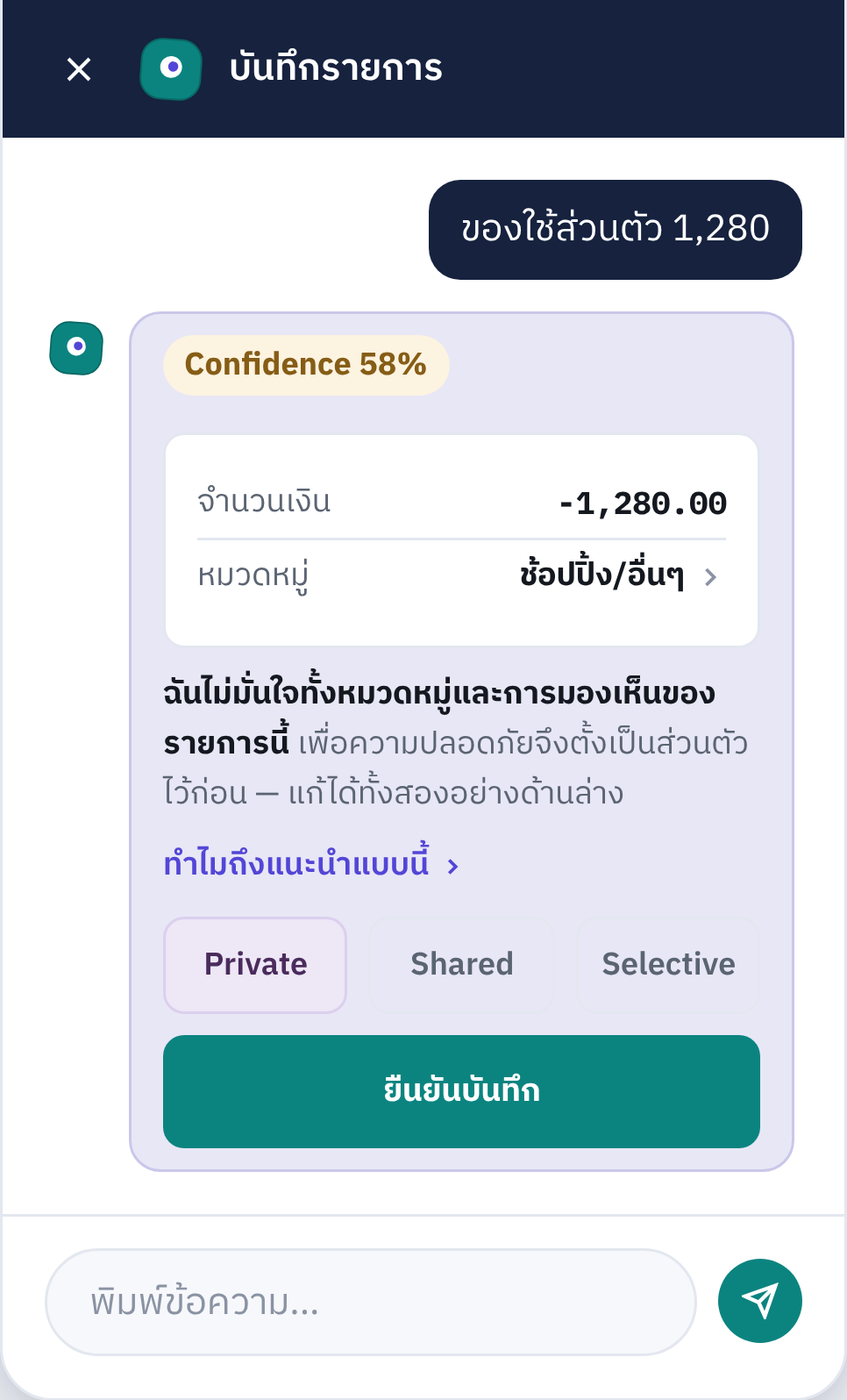
When uncertain, keep the transaction private first
This image shows a design idea for a moment when AI is uncertain about both category and visibility. The prototype selects Private first, explains why, and lets the person change it.
The choice accepts an extra decision before sharing rather than risking disclosure of a transaction that should remain private. Convenience is not the only consideration in choosing a default.
This is behaviour expressed in a design prototype. It is not evidence that AI classification has been implemented or that it achieves any particular accuracy.
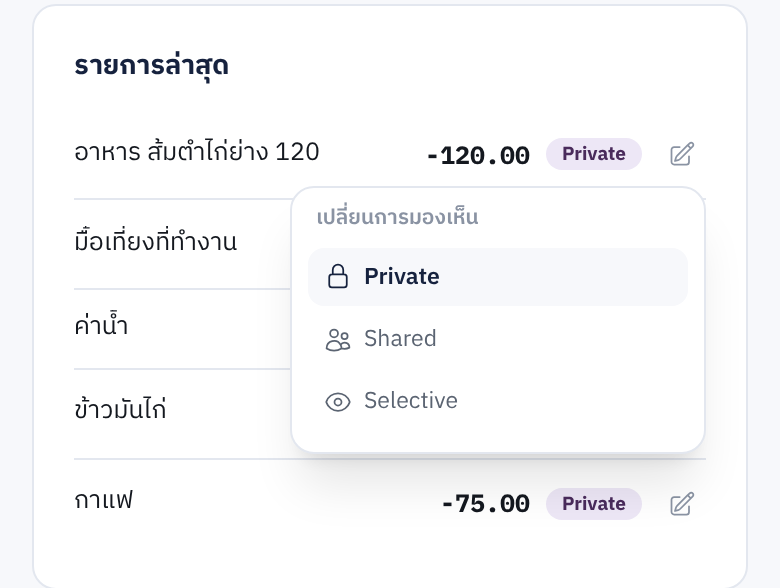
The first choice may not be the last
The prototype also includes selecting who can see a transaction and changing visibility afterwards. It is another part of the same question: a person should be able to revisit a transaction’s boundary.
Changing an option on a screen does not answer what happens to information someone else has already seen. I do not treat these images as a guarantee that disclosure can be undone.
Numbers describe an agreement; they do not decide what is fair
Choices in dootang extend beyond who can see which information. They also include who chooses the proportions for sharing money. Even a precise number has an agreement behind it.
In the calculation-detail prototype, the proportions come from an agreement already set and are then expressed as amounts of money. They are not calculated automatically from income or other factors. The screen explains the amounts that follow from the chosen proportions; it does not establish that those proportions are fair.
For me, the design work therefore extends beyond displaying the amounts correctly. It includes making the choices behind the numbers visible, and making clear what those numbers cannot decide for people, particularly when care and other non-monetary contributions are involved.
This is design reasoning, not a finding from testing with real families. The open questions are whether people understand and accept the same agreement, and how they would revisit it when their circumstances change.
What these images cannot answer
Images let us examine the design intent. They do not establish system security, people’s understanding of the choices, or an effect on relationships within a household.
The open questions include whether people distinguish Shared from Selective, whether a Private default under uncertainty helps or confuses them, and what limits should apply when visibility changes afterwards.
Returning to the right to choose
What I return to through dootang is that sharing information is more than a stored setting. It is a choice with consequences for other people. Making that boundary and that choice visible is part of the design work.
The work is still in development. I want to keep both the reasons behind choices and the open questions, so I can revisit them when the design meets real use.